 Add to Chrome
 Add to Firefox
 Add to Edge
TraceCodec: A Compiler-Backed Neural Codec for Stateful Multi-Flow Network Traffic Traces
May 28, 2026
Critical networking workflows require high-fidelity packet captures (PCAPs) for testing, security analysis, and protocol validation, not just statistical flow-level summaries. Recent packet generators have demonstrated protocol-constrained PCAP synthesis, but they universally decode directly to raw packet fields. That interface entangles learned behavioral choices with deterministic protocol consequences, which forces packet realization to depend on post-hoc heuristic repair. We identify this decode interface as the fundamental bottleneck and present TraceCodec, a state-aware neural codec for stateful multi-flow traces. TraceCodec lifts each packet into a timed packet action with explicit flow slots and transport cues, then learns a continuous per-packet latent. A deterministic compiler lowers decoded actions back to PCAPs, owning endpoint assignment, TCP state, legality constraints, and packet rendering. The latent layer exposes a generator-facing sequence space, so downstream traffic models can operate on packet-action latents rather than raw header fields. On CICIDS2017 Monday, TraceCodec matches packet count, protocol composition, and flow population to within 0.03%. Raw-field baselines under the same non-repair policy distort flow counts and TCP state by orders of magnitude. Structural diagnostics show that TraceCodec preserves TCP state transitions and multi-flow interleaving that raw-field decoders fragment. This work establishes a new foundation for high-fidelity packet-trace generation.

OmniVerifier-M1: Multimodal Meta-Verifier with Explicit Structured Recalibration
May 27, 2026Visual outcomes are increasingly central to multimodal large language models, making reliable and fine-grained verification essential for scaling generalist foundation models. In this work, we investigate multimodal meta-verification, which leverages verifier-generated rationales rather than decision-only signals, and explore how to effectively incorporate meta-verification feedback into multimodal verifier training. We identify two key findings. First, symbolic verifier outputs (e.g., bounding boxes) outperform textual explanations as meta-verification rationales, enabling efficient rule-based reinforcement learning rewards while avoiding reliance on model-based rewards from auxiliary judge models. Second, decoupling reinforcement learning objectives for binary judgment and meta-verification substantially outperforms joint reward optimization, due to intrinsic differences in output structure and learning dynamics. Based on these insights, we train OmniVerifier-M1, a generalist visual verifier leveraging symbolic meta-verification and decoupled reinforcement learning. OmniVerifier-M1 provides robust verification and fine-grained error localization, and further enables M1-TTS, a verifier-driven agentic generation system achieving dynamic region-level self-correction. This approach paves the way for more reliable, interpretable, and fine-grained multimodal verification, supporting safer and more controllable foundation model deployment.
NoteIt: A System Converting Instructional Videos to Interactable Notes Through Multimodal Video Understanding
Aug 20, 2025
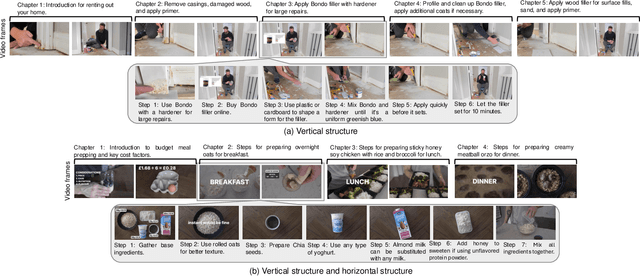
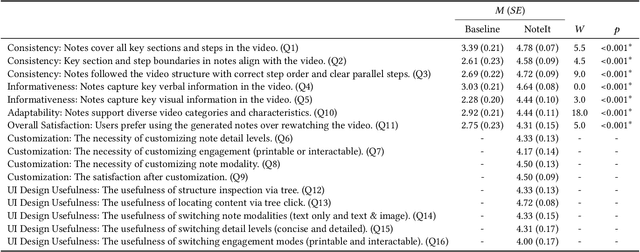

Users often take notes for instructional videos to access key knowledge later without revisiting long videos. Automated note generation tools enable users to obtain informative notes efficiently. However, notes generated by existing research or off-the-shelf tools fail to preserve the information conveyed in the original videos comprehensively, nor can they satisfy users' expectations for diverse presentation formats and interactive features when using notes digitally. In this work, we present NoteIt, a system, which automatically converts instructional videos to interactable notes using a novel pipeline that faithfully extracts hierarchical structure and multimodal key information from videos. With NoteIt's interface, users can interact with the system to further customize the content and presentation formats of the notes according to their preferences. We conducted both a technical evaluation and a comparison user study (N=36). The solid performance in objective metrics and the positive user feedback demonstrated the effectiveness of the pipeline and the overall usability of NoteIt. Project website: https://zhaorunning.github.io/NoteIt/
PeRL: Permutation-Enhanced Reinforcement Learning for Interleaved Vision-Language Reasoning
Jun 17, 2025Inspired by the impressive reasoning capabilities demonstrated by reinforcement learning approaches like DeepSeek-R1, recent emerging research has begun exploring the use of reinforcement learning (RL) to enhance vision-language models (VLMs) for multimodal reasoning tasks. However, most existing multimodal reinforcement learning approaches remain limited to spatial reasoning within single-image contexts, yet still struggle to generalize to more complex and real-world scenarios involving multi-image positional reasoning, where understanding the relationships across images is crucial. To address this challenge, we propose a general reinforcement learning approach PeRL tailored for interleaved multimodal tasks, and a multi-stage strategy designed to enhance the exploration-exploitation trade-off, thereby improving learning efficiency and task performance. Specifically, we introduce permutation of image sequences to simulate varied positional relationships to explore more spatial and positional diversity. Furthermore, we design a rollout filtering mechanism for resampling to focus on trajectories that contribute most to learning optimal behaviors to exploit learned policies effectively. We evaluate our model on 5 widely-used multi-image benchmarks and 3 single-image benchmarks. Our experiments confirm that PeRL trained model consistently surpasses R1-related and interleaved VLM baselines by a large margin, achieving state-of-the-art performance on multi-image benchmarks, while preserving comparable performance on single-image tasks.
MMaDA: Multimodal Large Diffusion Language Models
May 21, 2025We introduce MMaDA, a novel class of multimodal diffusion foundation models designed to achieve superior performance across diverse domains such as textual reasoning, multimodal understanding, and text-to-image generation. The approach is distinguished by three key innovations: (i) MMaDA adopts a unified diffusion architecture with a shared probabilistic formulation and a modality-agnostic design, eliminating the need for modality-specific components. This architecture ensures seamless integration and processing across different data types. (ii) We implement a mixed long chain-of-thought (CoT) fine-tuning strategy that curates a unified CoT format across modalities. By aligning reasoning processes between textual and visual domains, this strategy facilitates cold-start training for the final reinforcement learning (RL) stage, thereby enhancing the model's ability to handle complex tasks from the outset. (iii) We propose UniGRPO, a unified policy-gradient-based RL algorithm specifically tailored for diffusion foundation models. Utilizing diversified reward modeling, UniGRPO unifies post-training across both reasoning and generation tasks, ensuring consistent performance improvements. Experimental results demonstrate that MMaDA-8B exhibits strong generalization capabilities as a unified multimodal foundation model. It surpasses powerful models like LLaMA-3-7B and Qwen2-7B in textual reasoning, outperforms Show-o and SEED-X in multimodal understanding, and excels over SDXL and Janus in text-to-image generation. These achievements highlight MMaDA's effectiveness in bridging the gap between pretraining and post-training within unified diffusion architectures, providing a comprehensive framework for future research and development. We open-source our code and trained models at: https://github.com/Gen-Verse/MMaDA
Seed1.5-VL Technical Report
May 11, 2025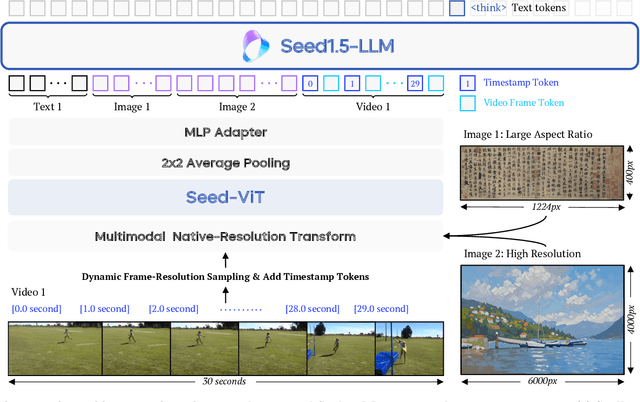

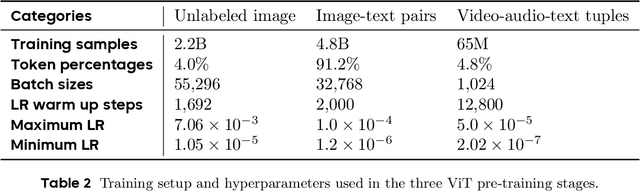
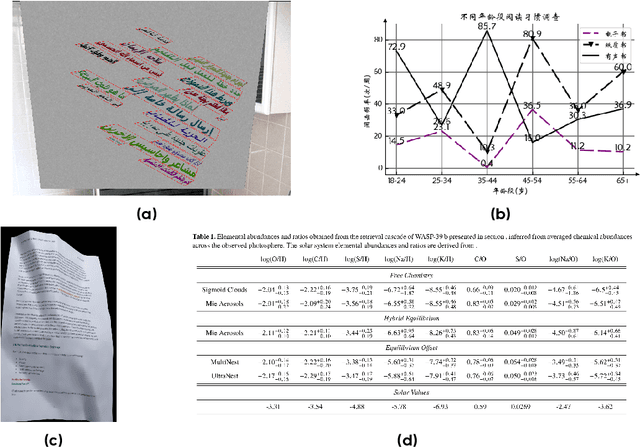
We present Seed1.5-VL, a vision-language foundation model designed to advance general-purpose multimodal understanding and reasoning. Seed1.5-VL is composed with a 532M-parameter vision encoder and a Mixture-of-Experts (MoE) LLM of 20B active parameters. Despite its relatively compact architecture, it delivers strong performance across a wide spectrum of public VLM benchmarks and internal evaluation suites, achieving the state-of-the-art performance on 38 out of 60 public benchmarks. Moreover, in agent-centric tasks such as GUI control and gameplay, Seed1.5-VL outperforms leading multimodal systems, including OpenAI CUA and Claude 3.7. Beyond visual and video understanding, it also demonstrates strong reasoning abilities, making it particularly effective for multimodal reasoning challenges such as visual puzzles. We believe these capabilities will empower broader applications across diverse tasks. In this report, we mainly provide a comprehensive review of our experiences in building Seed1.5-VL across model design, data construction, and training at various stages, hoping that this report can inspire further research. Seed1.5-VL is now accessible at https://www.volcengine.com/ (Volcano Engine Model ID: doubao-1-5-thinking-vision-pro-250428)
Diffusion-Sharpening: Fine-tuning Diffusion Models with Denoising Trajectory Sharpening
Feb 17, 2025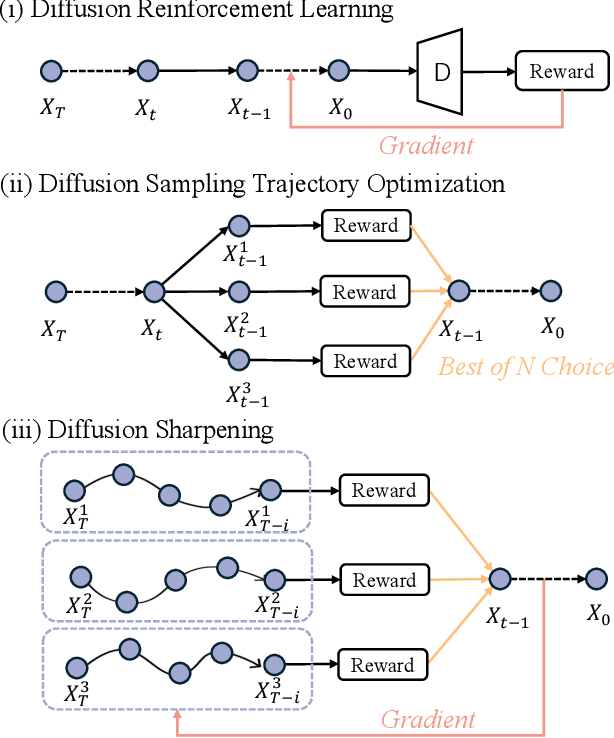
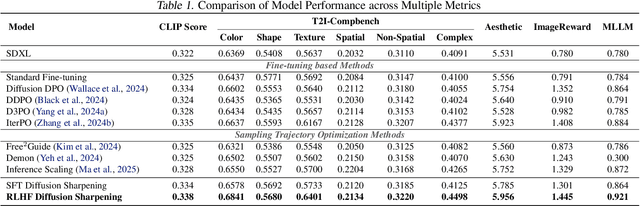
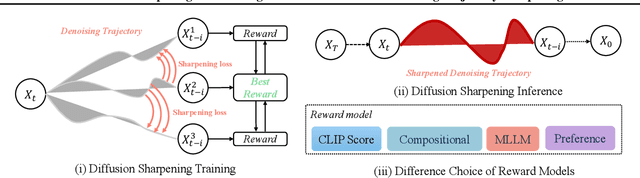
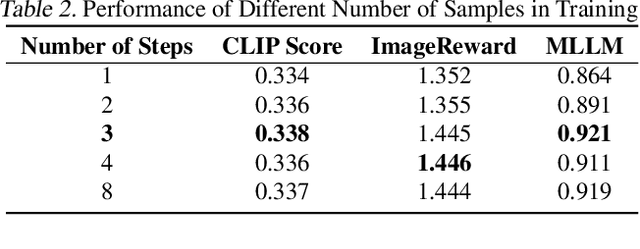
We propose Diffusion-Sharpening, a fine-tuning approach that enhances downstream alignment by optimizing sampling trajectories. Existing RL-based fine-tuning methods focus on single training timesteps and neglect trajectory-level alignment, while recent sampling trajectory optimization methods incur significant inference NFE costs. Diffusion-Sharpening overcomes this by using a path integral framework to select optimal trajectories during training, leveraging reward feedback, and amortizing inference costs. Our method demonstrates superior training efficiency with faster convergence, and best inference efficiency without requiring additional NFEs. Extensive experiments show that Diffusion-Sharpening outperforms RL-based fine-tuning methods (e.g., Diffusion-DPO) and sampling trajectory optimization methods (e.g., Inference Scaling) across diverse metrics including text alignment, compositional capabilities, and human preferences, offering a scalable and efficient solution for future diffusion model fine-tuning. Code: https://github.com/Gen-Verse/Diffusion-Sharpening
HermesFlow: Seamlessly Closing the Gap in Multimodal Understanding and Generation
Feb 17, 2025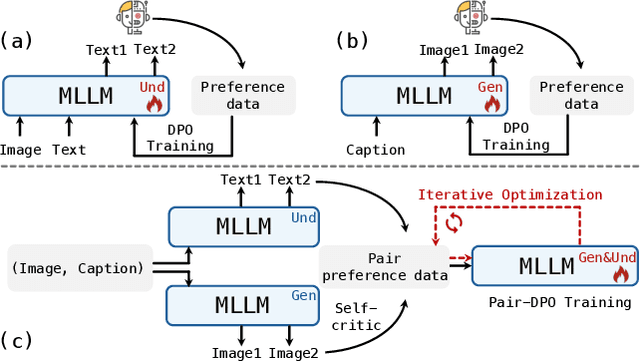
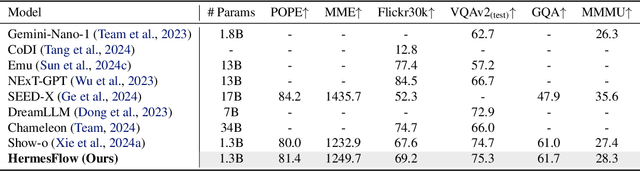
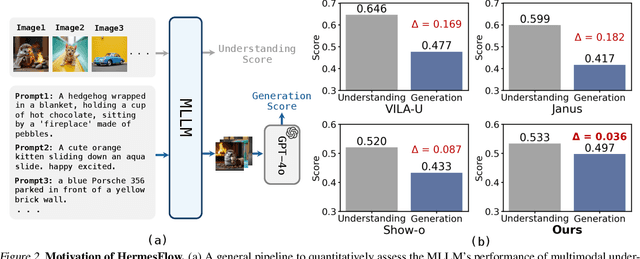
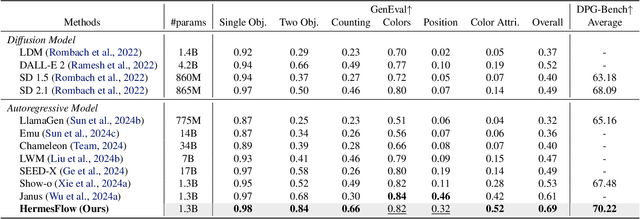
The remarkable success of the autoregressive paradigm has made significant advancement in Multimodal Large Language Models (MLLMs), with powerful models like Show-o, Transfusion and Emu3 achieving notable progress in unified image understanding and generation. For the first time, we uncover a common phenomenon: the understanding capabilities of MLLMs are typically stronger than their generative capabilities, with a significant gap between the two. Building on this insight, we propose HermesFlow, a simple yet general framework designed to seamlessly bridge the gap between understanding and generation in MLLMs. Specifically, we take the homologous data as input to curate homologous preference data of both understanding and generation. Through Pair-DPO and self-play iterative optimization, HermesFlow effectively aligns multimodal understanding and generation using homologous preference data. Extensive experiments demonstrate the significant superiority of our approach over prior methods, particularly in narrowing the gap between multimodal understanding and generation. These findings highlight the potential of HermesFlow as a general alignment framework for next-generation multimodal foundation models. Code: https://github.com/Gen-Verse/HermesFlow
Continual Learning with Strategic Selection and Forgetting for Network Intrusion Detection
Dec 20, 2024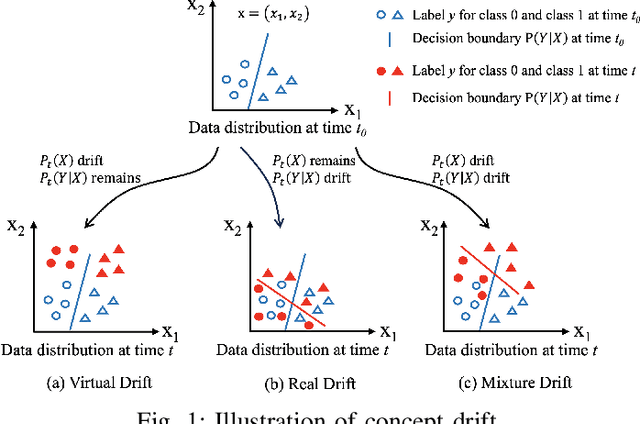

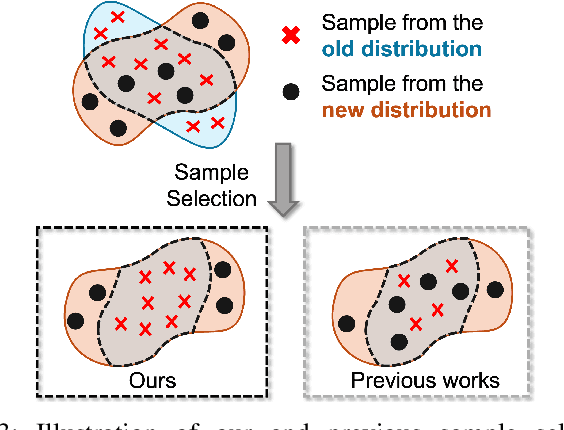
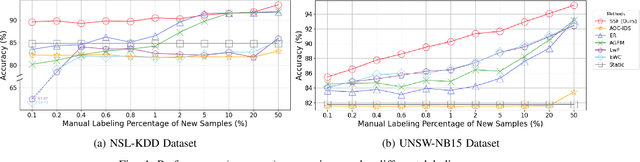
Intrusion Detection Systems (IDS) are crucial for safeguarding digital infrastructure. In dynamic network environments, both threat landscapes and normal operational behaviors are constantly changing, resulting in concept drift. While continuous learning mitigates the adverse effects of concept drift, insufficient attention to drift patterns and excessive preservation of outdated knowledge can still hinder the IDS's adaptability. In this paper, we propose SSF (Strategic Selection and Forgetting), a novel continual learning method for IDS, providing continuous model updates with a constantly refreshed memory buffer. Our approach features a strategic sample selection algorithm to select representative new samples and a strategic forgetting mechanism to drop outdated samples. The proposed strategic sample selection algorithm prioritizes new samples that cause the `drifted' pattern, enabling the model to better understand the evolving landscape. Additionally, we introduce strategic forgetting upon detecting significant drift by discarding outdated samples to free up memory, allowing the incorporation of more recent data. SSF captures evolving patterns effectively and ensures the model is aligned with the change of data patterns, significantly enhancing the IDS's adaptability to concept drift. The state-of-the-art performance of SSF on NSL-KDD and UNSW-NB15 datasets demonstrates its superior adaptability to concept drift for network intrusion detection.
IterComp: Iterative Composition-Aware Feedback Learning from Model Gallery for Text-to-Image Generation
Oct 09, 2024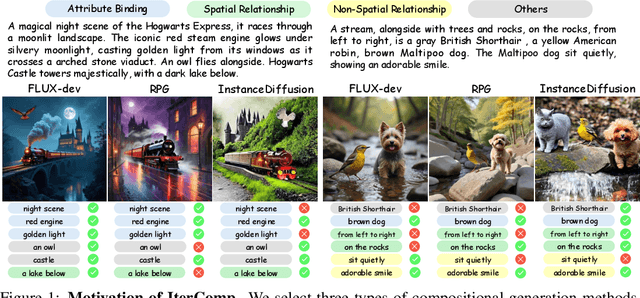


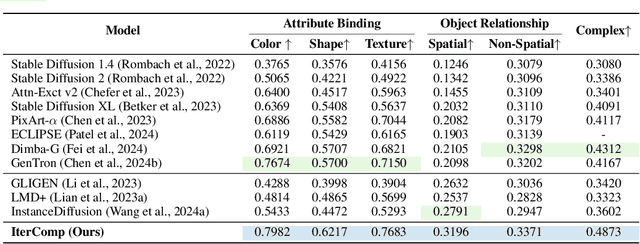
Advanced diffusion models like RPG, Stable Diffusion 3 and FLUX have made notable strides in compositional text-to-image generation. However, these methods typically exhibit distinct strengths for compositional generation, with some excelling in handling attribute binding and others in spatial relationships. This disparity highlights the need for an approach that can leverage the complementary strengths of various models to comprehensively improve the composition capability. To this end, we introduce IterComp, a novel framework that aggregates composition-aware model preferences from multiple models and employs an iterative feedback learning approach to enhance compositional generation. Specifically, we curate a gallery of six powerful open-source diffusion models and evaluate their three key compositional metrics: attribute binding, spatial relationships, and non-spatial relationships. Based on these metrics, we develop a composition-aware model preference dataset comprising numerous image-rank pairs to train composition-aware reward models. Then, we propose an iterative feedback learning method to enhance compositionality in a closed-loop manner, enabling the progressive self-refinement of both the base diffusion model and reward models over multiple iterations. Theoretical proof demonstrates the effectiveness and extensive experiments show our significant superiority over previous SOTA methods (e.g., Omost and FLUX), particularly in multi-category object composition and complex semantic alignment. IterComp opens new research avenues in reward feedback learning for diffusion models and compositional generation. Code: https://github.com/YangLing0818/IterComp